Chosen, Then Canceled: The Pro-Trans Law Dean Controversy Rocking Arkansas
The University of Arkansas withdrew its appointment of Emily Suski as law school dean just days after announcing her hire, sparking debates over political pressure, academic freedom, and governance at public universities.

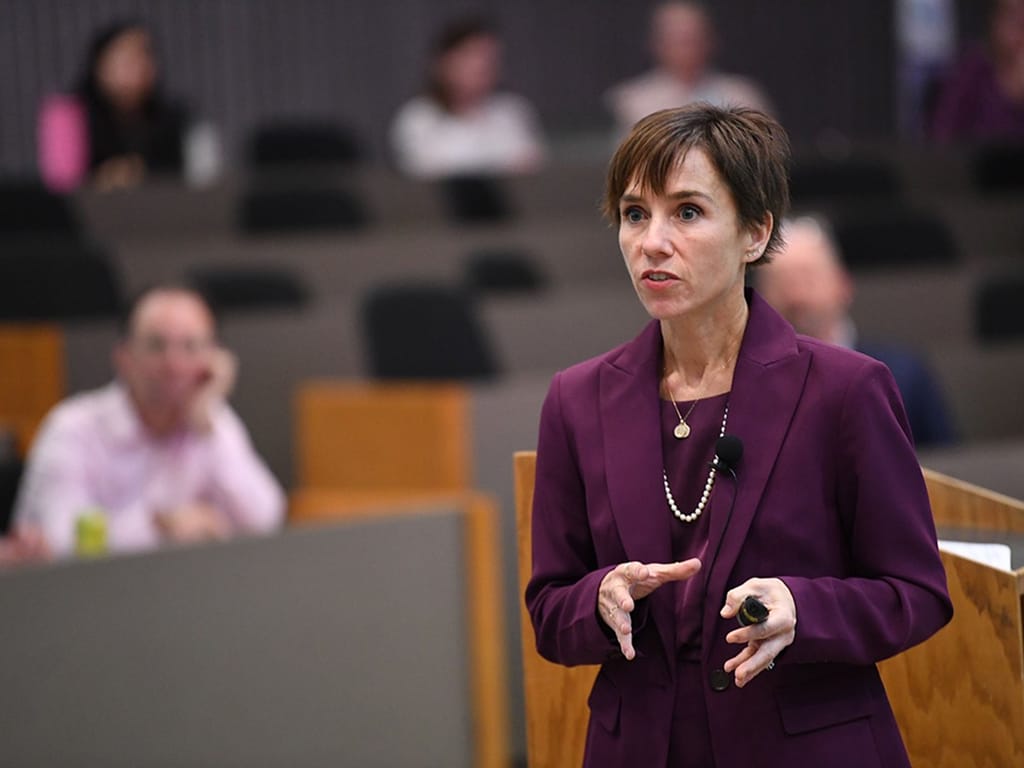
As Republicans and conservative activists across the country push to limit what they view as liberal influence in higher education, Arkansas has become part of the national wave. Under intense pressure, the University of Arkansas reversed its decision to hire pro-trans Emily Suski as dean of its School of Law, rescinding the offer less than a week after announcing she would assume the position on July 1.
University officials pointed to objections regarding Suski’s professional background and her legal positions on protections for transgender athletes. In a brief statement, they said the university had decided to go a different direction, citing feedback from “key external stakeholders.” The identities of those stakeholders and the weight their input carried in the final decision were not disclosed, though it is widely understood that conservative voices played a central role.
The sudden reversal at the University of Arkansas at Fayetteville has reignited debates over academic independence, political influence, and who ultimately determines leadership at public universities. Democrats and members of the legal community called the move a dangerous precedent, warning it signals political interference in academic hiring. Republicans, by contrast, praised the decision as a step to protect students from what they see as excessive liberal influence in the universities.
Background on the Candidate
Emily Suski, a professor and associate dean at the University of South Carolina’s Joseph F. Rice School of Law, emerged as one of four finalists for the deanship at the University of Arkansas School of Law, a position that has sat unfilled for nearly two years. Suski has been on the faculty at South Carolina’s law school since 2016. Between 2022 and 2025, she served as associate dean for clinics and externships, overseeing experiential learning programs, before stepping into her current role as associate dean for strategic and institutional priorities, where her work has focused on long term planning and administration.
She is also the founding faculty director of the Carolina Health Advocacy Medicolegal Partnership and an affiliate assistant professor in the Department of Pediatrics at the Medical University of South Carolina. Before joining South Carolina, Suski held faculty positions at Georgia State University College of Law, Morehouse School of Medicine, and the University of Virginia School of Law. She also worked as a staff attorney with the JustChildren Program of the Legal Aid Justice Center in Charlottesville, Virginia.
Most notably, Suski was one of 17 legal scholars who signed an amicus brief advocating for protections for transgender students under Title IX. That legal position has become politically charged in Arkansas, where a similar ban on transgender athletes is already in effect.
University Response
University officials declined to provide additional details on their decision, citing only feedback from external stakeholders.
“After receiving feedback from key external stakeholders about the fit between Professor Suski and the university’s vacancy, the university has decided to go a different direction in filling the vacancy,” the statement said. “University officials are very grateful for Professor Suski’s interest in the position and continue to hold Professor Suski in high regard. We wish Professor Suski well as she moves forward with her career.”
Suski said Thursday evening that she was honored to have been selected and had been preparing to serve the students, faculty, and the state of Arkansas with integrity and commitment.
“I am disappointed and hurt by the University’s decision to rescind my contract,” Suski said in an email. “I have been informed that the decision was not in any way a reflection of my qualifications to serve as dean, but rather the result of influence from external individuals. Questions concerning that feedback are best directed to the University of Arkansas.”
The reversal came eight days after the university sent Suski a signed letter offering her total annual compensation of $350,000, contingent on approval by the University of Arkansas Board of Trustees.
Legislative Influence and Political Reaction
When asked why the appointment was withdrawn, Senate President Pro Tempore Bart Hester said he had personally communicated his opposition to university leaders, suggesting the decision was not made unilaterally and reflected strong concerns on his part.
“I can’t speak for the University of Arkansas,” Hester said, “but from my position, I was very clear with my contacts at the University of Arkansas about how strongly I disapproved of that hire.”
Pressed on what the decision signals about academic leadership and institutional independence, and whether it was based on professional qualifications or Suski’s publicly expressed views, Hester said he does not separate the two.
“We agree on diversity of thought and education, totally agree with that,” Hester said. “But this was a potential dean who disagreed with the very foundations of society. She didn’t understand what a woman was. She didn’t understand how important it was to protect women in sports.”
Hester argued that leadership at a publicly funded institution comes with inherent limits.
“Her judicial philosophy is her professional qualifications,” he said. “She’s wanting to go work for the people of Arkansas. It’s called the University of Arkansas because the people of Arkansas pay for it. It’s a land grant institution. Tax dollars are the number one donor.”
“It is very important that we don’t have someone changing an entire philosophy that hard-working Arkansans totally disagree with,” Hester added. “She can absolutely hold that philosophy at a private school. She cannot do so where we’re asking the taxpayers of Arkansas to give their hard-earned money to someone who is going to teach something that will influence ideas we know are ridiculous.”
Democratic Lawmakers Raise Alarm
Democratic Rep. Ashley Hudson, a graduate of the University of Arkansas School of Law, said the decision represents a troubling precedent.
“As a proud graduate of the University of Arkansas School of Law and a member of the legal community, I’m deeply disappointed that a well qualified, preeminent legal scholar was pushed aside after a thorough vetting process because unnamed stakeholders objected to her advocacy in an amicus brief,” Hudson said.
Hudson said the consequences extend well beyond a single hiring decision.
“Lawyers are trained to advocate for clients and causes, even when those positions are controversial,” she said. “Our profession depends on the free exchange of ideas and healthy debate, and it’s troubling to see that principle undermined by those who do not share that commitment.”
In a social media post, Rep. Nicole Clowney, D Fayetteville, alleged that Suski’s employment offer was withdrawn after certain members of the Arkansas Legislature and one constitutional officer objected to Suski’s political views and threatened the university’s budget if she were hired.
“I am still gathering information, but based on what I’ve learned so far, it seems clear that what happened is a horrifying, unprecedented, and absolutely unconstitutional abuse of state power,” Clowney wrote.
Clowney said the objections stemmed from Suski’s support of litigation challenging laws related to transgender athletes in sports.
“Veiled threats and comments behind closed doors about the political leanings of University of Arkansas faculty and staff are nothing new, sadly,” Clowney wrote. “But state elected officials threatening to withhold funding from the entire school based on the political beliefs of the newly hired dean is a new, terrifying low.”
She warned that the consequences could be long lasting.
“It is quite literally state government prohibiting the free exercise of speech,” Clowney said. “This move will irrevocably undermine morale of faculty and staff who already live in a state of constant fear of retaliation for expressing their personal beliefs. It will frighten anyone who is considering moving to Arkansas to work at the U of A.”
Republican Leaders Say Suski Was Not the Right Fit
Attorney General Tim Griffin clarified that he did not request the university to rescind Suski’s offer. In a statement, his spokesperson said, “The Attorney General simply expressed his dismay at the selection and his confidence that many more qualified candidates could have been identified. He never requested or even contemplated that the offer be rescinded, but he applauds the decision nonetheless.”
The governor’s office also praised the university’s action. “Governor Sanders appreciates the University of Arkansas, Fayetteville, for reaching the commonsense decision on this matter in the best interests of students,” a spokesperson said.
Broader Implications for Academic Freedom
Republican lawmakers in Arkansas have moved to curb what they describe as liberal ideology in public classrooms. As the state’s politics have increasingly aligned with Christian conservative priorities, space for liberal ideas has narrowed, a shift that appears to enjoy broad public support. Debates over transgender issues, in particular, have become a recurring flashpoint.
Gov. Sarah Huckabee Sanders has framed her efforts for more Christian values in the school as a response to what she calls student indoctrination and has been an outspoken supporter of barring transgender athletes from school sports, a policy already in effect in Arkansas. She has also opposed Emily Suski’s appointment in connection with her support of transgenders.
“The implications are staggering,” said Holly Dickson, executive director of the American Civil Liberties Union of Arkansas. “This sends a chilling message to faculty members. Stay silent or risk your career.”
Critics have also voiced concern that academic freedom, long regarded as a cornerstone of higher education in the United States, is increasingly being constrained by ideological pressure and the threat of political retaliation.
Many in higher education worry that the decision signals further interventions ahead, with potential consequences for faculty, administrators, and curricula. The withdrawal of Suski’s appointment, they warn, may mark the opening chapter in a broader effort to reshape public universities in Arkansas.