Sanders’ Prison Strategy Gains Ground as Board Dynamics Shift
Gov. Sarah Huckabee Sanders gains leverage over the Arkansas Board of Corrections, strengthening her influence as she pushes forward her controversial plan for a 3,000-bed prison in Franklin County.

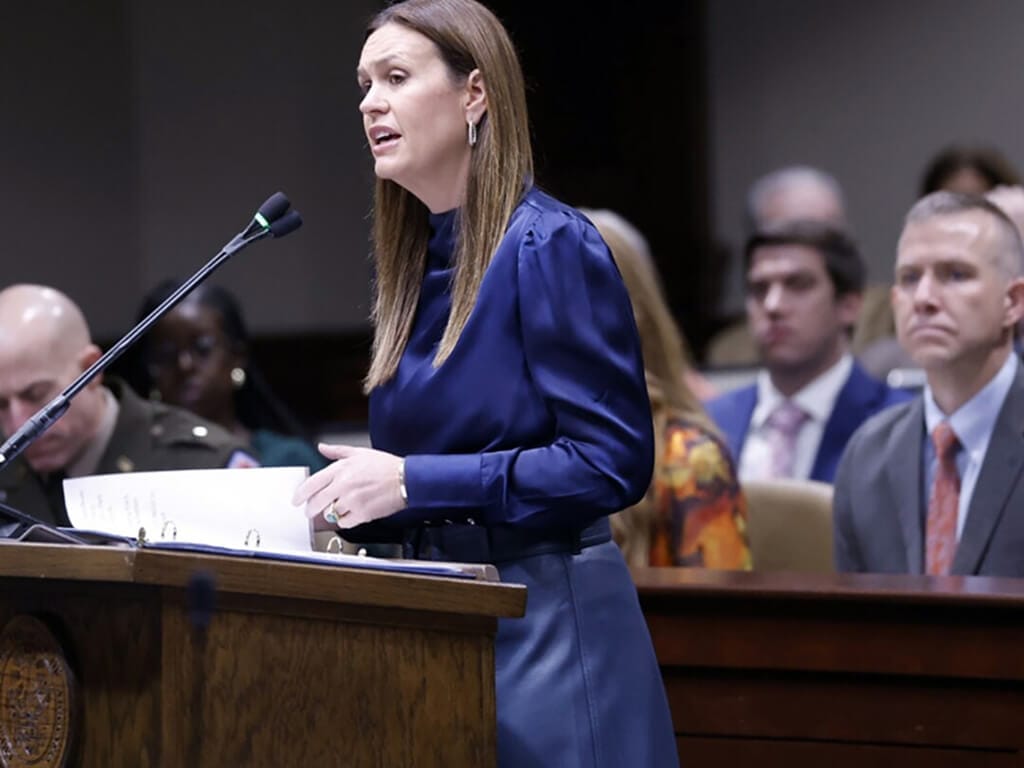
Gov. Sarah Huckabee Sanders has shown a sustained interest in reshaping how Arkansas operates its prison system. Since taking office, she has pushed for sweeping changes to prison management and oversight and has been especially focused on her plan to build a large-scale, 3,000 bed prison in Franklin County.
For much of her tenure, the Arkansas Board of Corrections stood as a significant obstacle to those ambitions, at times engaging in open and legal disputes over the limits of her authority. That dynamic is now shifting. Sanders’ efforts to curb the board’s independence and bring it more closely in line with her priorities appear to be gaining traction, as a newly formed majority on the panel gives the Republican governor greater leverage.
A Long History of Prison Controversy in Arkansas
Sanders is far from the first Arkansas governor to promise major reforms to the state’s prison system or sentencing laws. Nearly every governor in recent history has faced prison related controversies or sought to overhaul corrections policy.
Arkansas’ prison history is marked by episodes that have drawn national attention. Brutal conditions in the prison system inspired the 1980 film Brubaker. At another point, blood tainted with HIV from people incarcerated at the Cummins Unit was knowingly sold. Oversight of the Department of Corrections has long been an area of intense public interest, with scrutiny often falling squarely on the governor. Sanders, too, has faced sustained criticism from the state, with each perceived failure bringing renewed attacks on her leadership.
More recently, state officials came under fire last year following the escape of a convicted murderer known as the “Devil in the Ozarks.”
A Public Break With the Board of Corrections
What sets Sanders apart from her predecessors is her approach toward the Arkansas Board of Corrections, an entity that has traditionally functioned as an ally to governors rather than an adversary.
That relationship began to fracture in 2023, when Sanders took the unusual step of holding a news conference to publicly criticize the board for refusing to approve a proposal to open temporary prison beds. Sanders said the beds were urgently needed to ease overcrowding, while board members questioned whether the prison system had enough staff to manage them safely.
The dispute opened a broader struggle over who ultimately controls Arkansas’ prison system.
At the center of that conflict was a law Sanders championed and signed that would have stripped the board of its authority to hire and fire the corrections secretary and other top officials. A Pulaski County judge later struck down the law, and the board went on to fire Sanders’ hand picked choice for corrections secretary.
A New Majority on the Board
Sanders did not retreat. When the time came to appoint new members to the Board of Corrections, she selected allies who shared her priorities. Her four appointees wasted little time asserting control once they formed a majority.
At their first meeting last month, held as Arkansas was under a state of emergency because of an impending winter storm, the new majority moved quickly to dismiss the private attorney the board had retained for its ongoing legal fight with the governor. The board also elected three Sanders appointees to its top leadership positions.
Although the law that would have limited the board’s authority has been struck down, the new alignment may grant Sanders much of the influence she has been seeking, if only indirectly. The decision to fire the board’s private attorney followed continuing litigation over whether the panel had the authority to hire him in the first place.
With the new majority in place, many observers expect the board’s actions to align more closely with Sanders’ priorities.
Focus Shifts to the Franklin County Prison Plan
With the board no longer posing the same level of resistance, attention has turned back to Sanders’ most ambitious and controversial correctional proposal: the Franklin County prison.
While supporters argue that a new prison is necessary, opposition has been fierce. Local officials say they were blindsided by the site selection and contract decisions. Residents have raised concerns about whether the area has the infrastructure needed to support a project of that size. Despite the pushback, Sanders has demonstrated a strong and persistent interest in seeing the project move forward.
The governor has argued that the prison is needed to address severe overcrowding in Arkansas facilities, which has forced the state to house inmates in local jails.
Even with her newfound leverage over the Board of Corrections, the underlying political dynamics surrounding the Franklin County project remain unchanged. Decisions about additional funding rest with the Arkansas Legislature, and the controversy is likely to overshadow the budget focused legislative session scheduled to begin in April.
A Prison Project Shapes Local Politics
The proposed prison has already impacted local politics in northwest Arkansas. On this occasion, The Senate District 26 seat became vacant following the death last year of Republican Sen. Gary Stubblefield. The district spans parts of Franklin, Logan, Johnson, and Sebastian counties and includes the proposed prison site in Franklin County. Stubblefield, who lived in Branch, emerged as one of the project’s most outspoken critics after it was announced in October 2024.
The special election to fill the seat was delayed by Gov. Sarah Huckabee Sanders following a key legislative session, a period during which her administration continued advancing the prison proposal. That delay ended only after a court ordered the election to be held before the next legislative session.
Now, in what is typically a Republican stronghold, voters are preparing to select the party’s nominee in a closely watched special primary runoff on Tuesday, February 3. The race has become largely defined by opposition to the prison project.
Both candidates in the runoff have said they are unequivocally opposed to locating a prison in Franklin County. One candidate, Dunn, has also publicly criticized the appointment of Jamie Barker, the governor’s former deputy chief of staff turned lobbyist, to the Arkansas Board of Corrections.
The other candidate, Simon, has said he did not approve of Barker’s selection as board chair. Barker was elected to the position last week during the first meeting in which Sanders’ appointees held a majority of the board’s seats.
The winner of Tuesday’s primary runoff will face independent candidate Adam Watson in the special general election scheduled for March 3. Watson has also opposed the prison, leaving voters with a rare contest in which resistance to the project unites every candidate on the ballot.
An Uncertain Path Forward
Her broader effort to overhaul the state’s prison system is now moving forward with fewer internal obstacles. The path for the Franklin County prison, however, remains uncertain. Local opposition is strong, legislative approval is not guaranteed, and whether Sanders’ expanded influence over the Board of Corrections will translate into success on her most ambitious prison project remains an open question.