As Traffic Swells, Highway 112 Expansion Moves Into Action
The expansion of Highway 112 will improve traffic flow, strengthen connectivity, and meet the needs of a fast growing region, with phase one starting early next year.

It has been a long standing demand, one that should have been addressed much earlier. Even though it comes late, it is finally happening. The Highway 112 expansion is moving forward at last.
In October, plans were approved for the more than 500 million dollar expansion. The project, divided into eight phases, broke ground in November, and preparations are now underway to begin construction of the first phase early next year. The full 18 mile, four lane corridor will include multiple roundabouts and turnabouts, a raised median, a sidewalk, and pedestrian tunnels.
Once completed, the upgraded highway is expected to carry more than 30,000 vehicles a day, easing congestion on the busy interstate and improving connectivity for local communities. The expansion is set to transform one of Northwest Arkansas’s most important transportation corridors and will definitely help the rapidly developing region.
A Corridor with Deep Local History
Arkansas Highway 112 passes through the heart of Northwest Arkansas, stretching 25.84 miles from Highway 16S in Fayetteville to Highway 12 in Bentonville. It stands as the only north south highway corridor in the metro area west of Interstate 49.
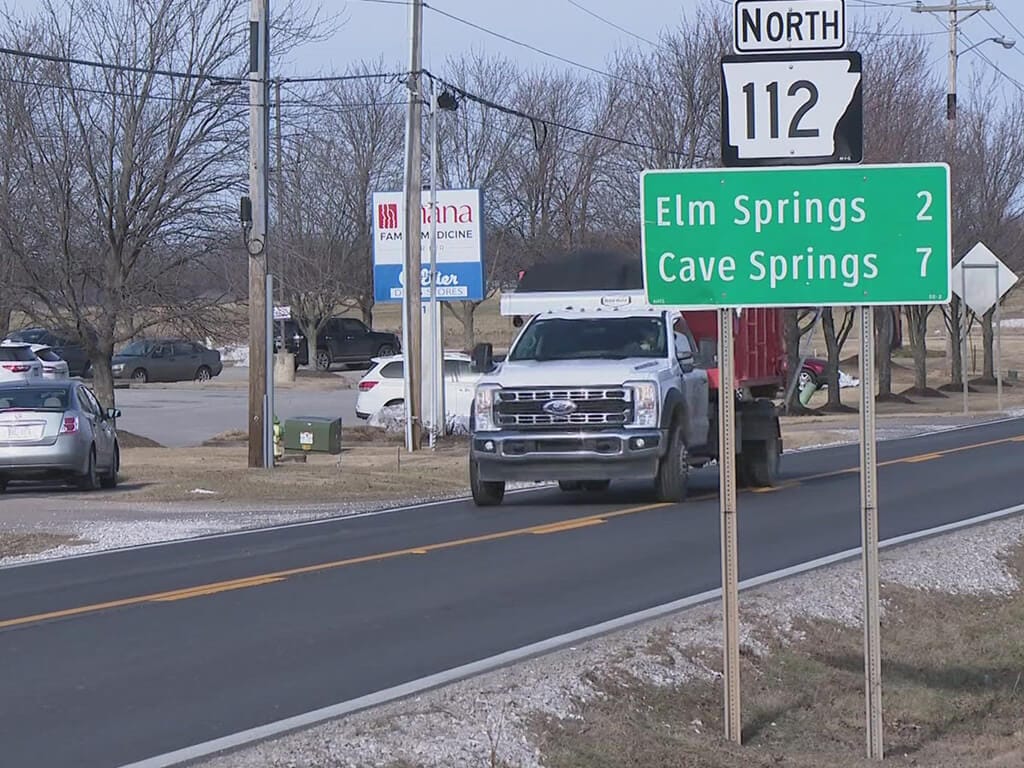
The route begins on Wedington Drive, just north of the University of Arkansas campus, and serves as a vital artery through Fayetteville. From there, it connects with US 71B at an interchange with I 49, US 62, and US 71. Continuing north toward Tontitown as Maestri Road, Highway 112 crosses US 412, passes through Elm Springs, and enters Benton County. In Cave Springs, the highway briefly overlaps with Highway 264 before reaching its northern end near the Bentonville Municipal Airport.
Highway 112 is one of the state’s original highways, first designated in 1926. Initially unpaved, it covered just 2.2 miles from Highway 16 in Fayetteville to a point south of Johnson. The route was paved in 1948 and extended north to Bentonville by 1951. By 1956, the entire stretch had been paved, and in 1971, the Highway 112S spur was created from a portion of Highway 16.
Efforts to Widen the Road
In the early 2000s, the Arkansas Department of Transportation (ARDOT), the City of Fayetteville, and the University of Arkansas reached an agreement to widen Highway 112 to four lanes between Highway 16 and I-49. Construction began in 2006 and progressed in segments as funding became available. Under the agreement, ARDOT would handle construction and financing, the City of Fayetteville would assume control and maintenance once the work was completed, and the University of Arkansas would maintain landscaping along the portion that passes through its campus.
In 2012, the route was shortened to its current northern terminus, no longer extending along Highway 12 and US 71B to Highway 72 in Bentonville. Even with this adjustment, Highway 112 still follows much of its historic path, forming part of both the Arkansas Civil War Trail and the northern route of the Trail of Tears.
As Northwest Arkansas grew, congestion increased rapidly. Highway 112 became a popular alternative to I-49, but its two-lane design soon reached capacity, especially with rising traffic to the Northwest Arkansas National Airport. ARDOT, the Northwest Arkansas Regional Planning Commission, and other state and local leaders worked for years to secure funding to expand and modernize the highway to handle increased traffic.
In September 2023, the Federal Highway Administration issued a Finding of No Significant Impact, allowing land acquisition and design work to move forward. The project was approved in October 2025, and with a gathering on November 6, the 500 million dollar effort officially began.
Leaders Welcome the New Development
At the groundbreaking, United States Representative Steve Womack underscored the project’s significance. He described the highway as a vital north–south artery in northwest Arkansas, one of the fastest growing regions in the country, and said that improving the corridor is essential not only to accommodate current growth but also to prepare for the surge still to come.
Arkansas Department of Transportation Director Jared D. Wiley reinforced that vision, emphasizing that the widening project reflects ARDOT’s commitment to safety and connectivity for everyone who travels the corridor. He noted that the addition of roundabouts will ease congestion at key intersections, while a new shared-use tunnel will offer cyclists and pedestrians a safe and accessible way to navigate the busy roadway.
Tim Conklin, executive director of the Regional Planning Commission, called the project long overdue. He pointed out that Highway 112 is the only north–south arterial west of I-49 connecting these cities. The route currently experiences heavy freight traffic and congestion and falls short in serving those trying to access trail systems or walk safely. Conklin said the project will improve the entire route, stretching from Fayetteville near Sam’s Club to the Bentonville Community Center.
He added that recurring congestion underscores the need for alternative routes. As the region continues to grow, additional roadway and highway networks are essential to complete the transportation grid so travelers are not dependent on only a few north–south corridors.
Looking Ahead
Construction on the first phase is set to begin in January and is expected to take about 18 months. This initial stretch, from Truckers Drive near Sam’s Club to Howard Nickell Road, will transform the corridor into a four-lane roadway with a raised center median.
City water and sewer lines will be relocated, three roundabouts and two turnarounds constructed, and sidewalks installed to improve accessibility. A 12-foot-wide shared-use path will give cyclists and pedestrians a dedicated space, while a pedestrian tunnel measuring 14 feet wide, 10 feet tall, and 177 feet long will be built just south of the roundabout at Van Asche Drive. Additional roundabouts are planned north of Truckers Drive and at Howard Nickell Road to improve traffic flow and safety throughout the corridor.
At the same time, ARDOT is advancing the planning, administrative, and organizational work for the remaining seven phases. Officials hope that by coordinating these efforts early, future segments can move forward without delay, keeping pace with the region’s rapid growth and ensuring Highway 112 can handle the demands of tomorrow.