A Federal Shift on Marijuana and What It Means in Arkansas
President Trump’s move to ease federal restrictions on cannabis prompts scrutiny in Arkansas, where marijuana laws remain strict.

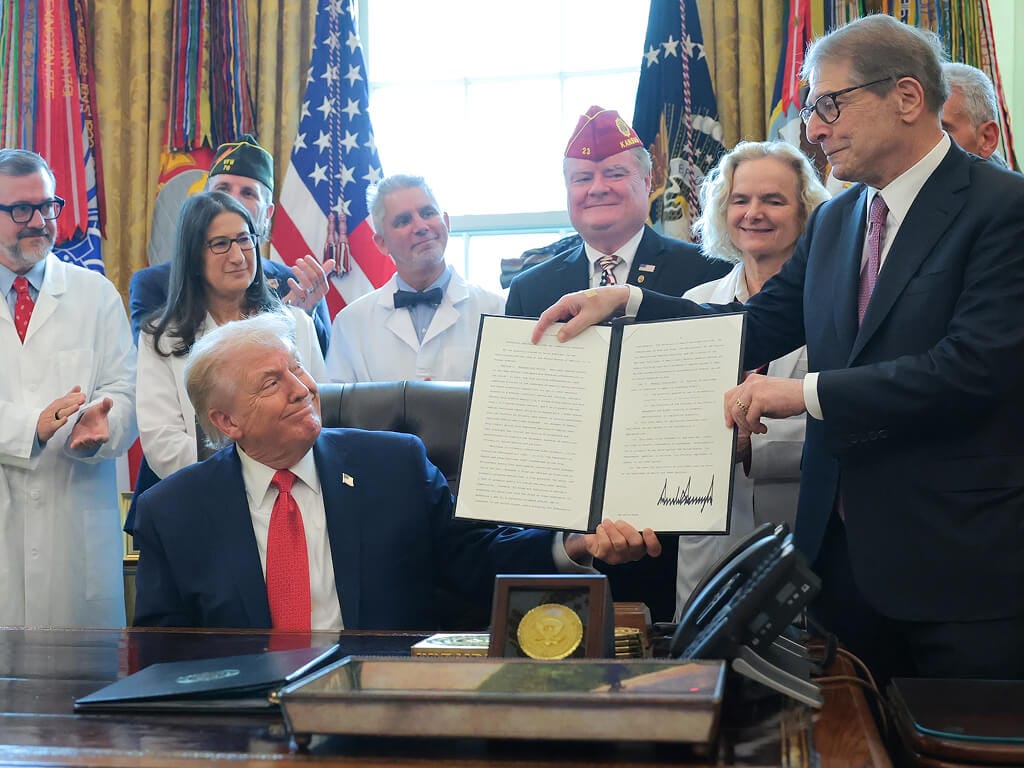
In an interesting development, President Trump on Thursday signed an executive order directing the federal government to downgrade cannabis from its most restrictive category of controlled substances.
The order does not decriminalize marijuana, but it eases certain federal limitations and expands opportunities for scientific research. It also authorizes a pilot program that would allow Medicare to reimburse patients for products made with cannabidiol, commonly known as CBD, a nonpsychoactive compound derived from cannabis.
The announcement has prompted questions and some confusion, particularly in states with stricter marijuana laws, including Arkansas, where officials are now weighing how the federal shift may intersect with existing state policies.
What the Order Does
Under the executive order, marijuana would be reclassified from a Schedule I drug, the same category as heroin, to a Schedule III drug, which includes substances such as ketamine.
The change would not legalize marijuana, as some states have done, nor would it alter how law enforcement handles marijuana-related arrests, according to senior administration officials who spoke on condition of anonymity.
“We have people begging for me to do this, people that are in great pain for decades,” Mr. Trump said while announcing the order from the Oval Office. He added, “It doesn’t legalize marijuana in any way, shape or form, and in no way sanctions its use as a recreational drug.”
Marijuana’s longstanding classification as one of the most dangerous and habit-forming substances has drawn criticism for years. Reclassifying the drug signals federal recognition that cannabis has medicinal value and a lower potential for abuse.
Mr. Trump’s order follows steps taken by the Biden administration to review marijuana’s classification, highlighting a broader shift in how both Republican and Democratic administrations view the substance.
Reactions to the Federal Shift
Not all conservatives supported President Trump’s move. Eighteen Republican senators and 26 House Republicans recently sent letters to the president opposing the reclassification. CatholicVote, a conservative nonprofit group, has also lobbied against the change.
“In light of the documented dangers of marijuana, facilitating the growth of the marijuana industry is at odds with growing our economy and encouraging healthy lifestyles for Americans,” the senators wrote. “We urge you to continue your strong leadership of our country and our economy, and to turn away from marijuana rescheduling.”
Trump’s executive order also drew mixed reactions from social justice advocates, who have long called for full decriminalization. Officials with the Last Prisoner Project, a nonprofit focused on freeing people incarcerated for cannabis offenses, praised the decision but urged the president to go further.
Support for the reclassification came from figures in the health and finance sectors. Howard Kessler, a billionaire financier and longtime Trump ally who advocated for the Medicare pilot program, praised the order.
“President Trump’s executive order has unleashed a seismic shift in health care, one of the boldest breakthroughs in generations,” Kessler, a leukemia survivor and founder of The Commonwealth Project, said in a statement. “While the rescheduling of cannabis will dominate the headlines, it’s his revolutionary pilot Medicare program that brings immediate, life-altering relief and access to cannabinoid-based therapies for millions of seniors grappling with chronic pain and debilitating conditions.”
What It Means for Arkansas
The announcement has drawn attention in Arkansas, a state with strict marijuana laws and a history of strong enforcement. Arkansas legalized medical marijuana through a voter-approved constitutional amendment in 2016.
State officials have emphasized that the executive order does not legalize marijuana and does not override Arkansas law. In a statement, a spokesperson for Arkansas Attorney General Tim Griffin said any federal reclassification would not alter or impact Arkansas’s constitutional provisions or marijuana laws.
“I don’t think anything in Arkansas has changed other than researchers who study the effects of medicine now will have more opportunity to study the effects of medical marijuana,” said Senator Ronald Caldwell, R-Wynne, who serves as co-chair of the Medical Marijuana Oversight Subcommittee.
“If you listen to the statements that President Trump made, it was to try to develop new treatments for these chronically ill patients, and especially those with cancer who may receive some relief,” Sen. Caldwell said. “And there’s other items out there too that can be treated, but I know that it is strictly a medical application, and the change in his executive order was strictly going to affect research.”
Sen. Caldwell said the most noticeable impact of the federal change would likely be felt in laboratories rather than dispensaries. “The researchers will be able to obtain samples and study them where in times past they have not,” he added.
Economic Implications
Drug policy experts say the most immediate effect of rescheduling marijuana could be financial relief for thousands of state-licensed cannabis businesses that currently face some of the highest federal taxes in the country. Because marijuana remains illegal at the federal level, businesses that grow and sell cannabis, including farms and dispensaries, cannot claim standard tax deductions for expenses such as rent and payroll.
In Arkansas, there are 38 state-licensed medical cannabis dispensaries, and more than 113,000 residents currently hold medical marijuana cards. The Arkansas Department of Finance and Administration, which serves as the liaison for the Arkansas Medical Marijuana Commission, said it is still reviewing the federal order.
“We are reviewing the details of the order to determine any impact to the state, including the medical marijuana industry. We do not have any specifics at this time as it will require additional review,” the agency said in a statement. Officials noted that the department would likely see the greatest effects if the federal reclassification is finalized.
Overall, the order is expected to have limited direct impact on Arkansas state. However, it may provide notable benefits for scientific research and for businesses navigating federal taxes while continuing to maintain strict oversight of medical use. The shift could also influence citizen-led efforts to expand legalization in the state.