A Push for Lower Bills and a Stronger Grid: Entergy Arkansas Details New Plan
Entergy Arkansas has unveiled a new plan aimed at improving affordability for customers while investing in upgrades to the state’s power grid to meet growing demand and long term reliability needs.

As Arkansas braces for a wave of new data centers, expanding industrial projects, and steady population growth, attention is increasingly focused on the state’s energy future. Lawmakers, business leaders, and residents have raised urgent questions about whether electricity supply can meet rising demand, how rates will be managed, and whether existing infrastructure can keep pace with rapid economic expansion. Calls for a clear, long-term energy strategy have grown louder in recent months.
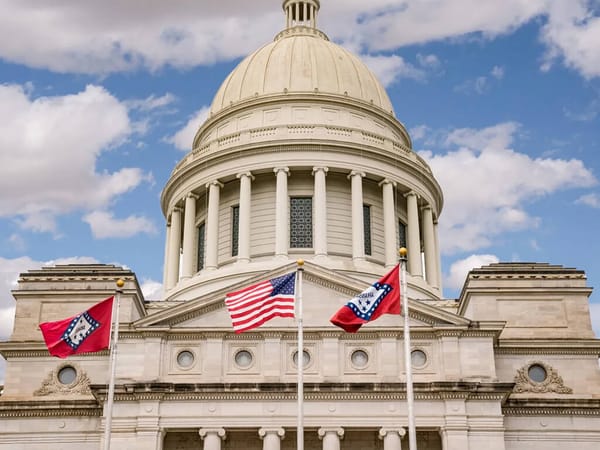
In response, officials from Entergy Arkansas, the state’s largest electric utility, joined state leaders on Thursday, December 18, at the Arkansas State Capitol to unveil a plan aimed at addressing these concerns and outlining how Arkansas intends to power its next phase of growth.
Next Generation Arkansas: A Comprehensive Energy Plan
Entergy Arkansas officials held a high-profile press conference to introduce Next Generation Arkansas, a comprehensive initiative to modernize the state’s energy system. Designed to meet rising energy demand, increasingly severe weather, and ongoing economic growth, the plan focuses on strengthening infrastructure, upgrading equipment, hardening the grid, and keeping electricity affordable for both residential and business customers.
The strategy centers on four key priorities: delivering better power, providing more power, supporting job growth, and maintaining affordability.
Laura Landreaux, President and CEO of Entergy Arkansas, led the presentation, joined by company executives, Arkansas Secretary of Commerce Hugh McDonald, and State Senator Jonathan Dismang of Searcy.
Key Components of the Plan
The plan calls for extending the operating life of existing generation facilities, including Arkansas Nuclear One, a two-unit pressurized water nuclear power plant on Lake Dardanelle near Russellville. Landreaux said Entergy intends to submit applications to federal and state regulators to extend the plant’s operating licenses. “In the long term, we’re seeking a license extension so we can operate those plants for another 20 years beyond their current licenses, which would end in 2034 and 2038,” she said. “We’ll be making that application with the Nuclear Regulatory Commission over the next several years.”
Other initiatives involve converting coal-fired plants to natural gas and continuing investments in renewable energy, including solar facilities and battery storage. A primary objective of these upgrades is to achieve a 40 percent increase in fuel efficiency.
Reducing outages and improving reliability are also major priorities. Entergy aims to eliminate nearly one in every three power outages across the state. The plan encompasses expanding renewable energy options, minimizing service interruptions, and introducing new tools to help customers manage and reduce their energy costs.
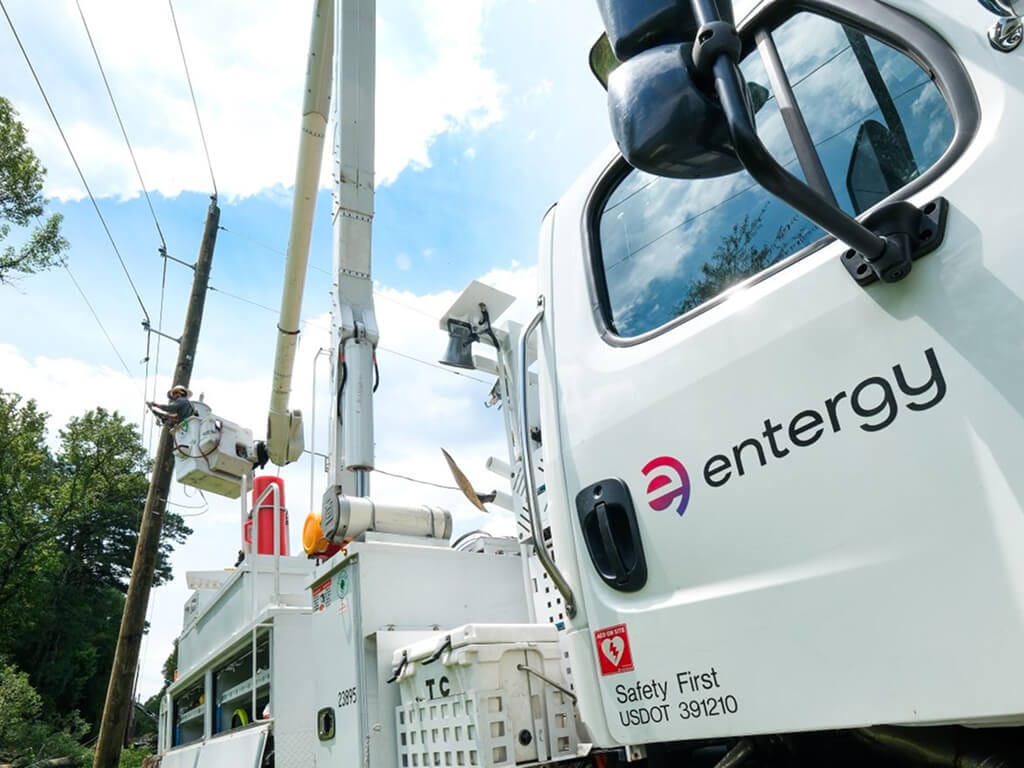
Entergy, which employs approximately 2,800 people across Arkansas and serves 63 of the state’s 75 counties, also plans to strengthen vegetation management efforts. Landreaux noted that fallen trees and overgrown vegetation contacting power lines are the leading causes of outages during severe weather.
The company will further invest in technology to better predict potential outages and use satellite imagery to enhance vegetation management, helping to keep the grid more reliable for customers.
Affordability and Customer Tools
For residents and businesses, electricity rates remain a top concern. Entergy noted that Arkansas electricity rates are currently 22 percent lower than the national average. The company is working to reduce costs, improve efficiency, and provide innovative billing solutions.
Landreaux said new rate options for residential customers are expected as part of an upcoming rate case filing. “We’ve got a new rate case that we’ll be filing at the conclusion of our formula rate plan at the beginning of next year,” she said. “As part of that rate case, we’ll be putting forth new options for customers to help them manage their usage at home and take more control over their bill.”
Landreaux also highlighted the role of growth in offsetting costs. New businesses and customers generate additional revenue, helping ease financial pressures. “The beauty of the plan is that we are bringing in this customer growth, and it is bringing in additional revenue that helps us offset the cost,” she said. “That will put downward pressure on rates as we move forward with the plan.”
Energy as a Driver for Economic Growth
The plan addresses Arkansas’ growing energy needs amid the state’s economic expansion. Secretary of Commerce Hugh McDonald, a former Entergy Arkansas CEO, emphasized the critical role of reliable power in driving economic development. For businesses considering expansion in the state, energy availability has become a top priority.
McDonald highlighted investments in steel, lithium, data centers, and distribution facilities, noting that Arkansas saw $6.7 billion in investments last year, creating more than 4,000 jobs. “Making changes like that are risky, but it is working,” McDonald said. “It is giving us answers when we talk to prospects. We can get energy faster than other states.”
He also underscored the importance of recent legislative changes that allow utilities to recover costs earlier during generation buildouts, a key factor in attracting major projects. “Google would not have happened without this,” he said, referring to the $4 billion data center announced in West Memphis in October.
State Sen. Jonathan Dismang, lead sponsor of recent energy legislation, said Arkansas is prioritizing reliable, affordable, and abundant power. “We are entering into a golden age in Arkansas,” Dismang said, citing legislation affecting energy, education, workforce development, and economic growth. “This is our goal in the state of Arkansas. To create reliable power, affordable power, dependable power.”
Dismang also pointed to the Generating Arkansas Jobs Act, which Entergy described as a blueprint for the Next Generation Arkansas plan. “We have a tool that our energy creators are going to be able to utilize to really help us advance forward,” he said.
Regulatory Filings and Oversight
The Next Generation Arkansas plan will involve multiple filings with the Arkansas Public Service Commission, and its total cost has not yet been determined. Landreaux said the overall investment is expected to reach billions of dollars and will be carried out in phases, subject to regulatory approval. The initiative is planned to roll out over the coming several years.