A National Conservative and a Local Question of Belonging
Challengers from both Republicans and Democrats are testing Tom Cotton’s dominance in Arkansas politics in the Senate election.

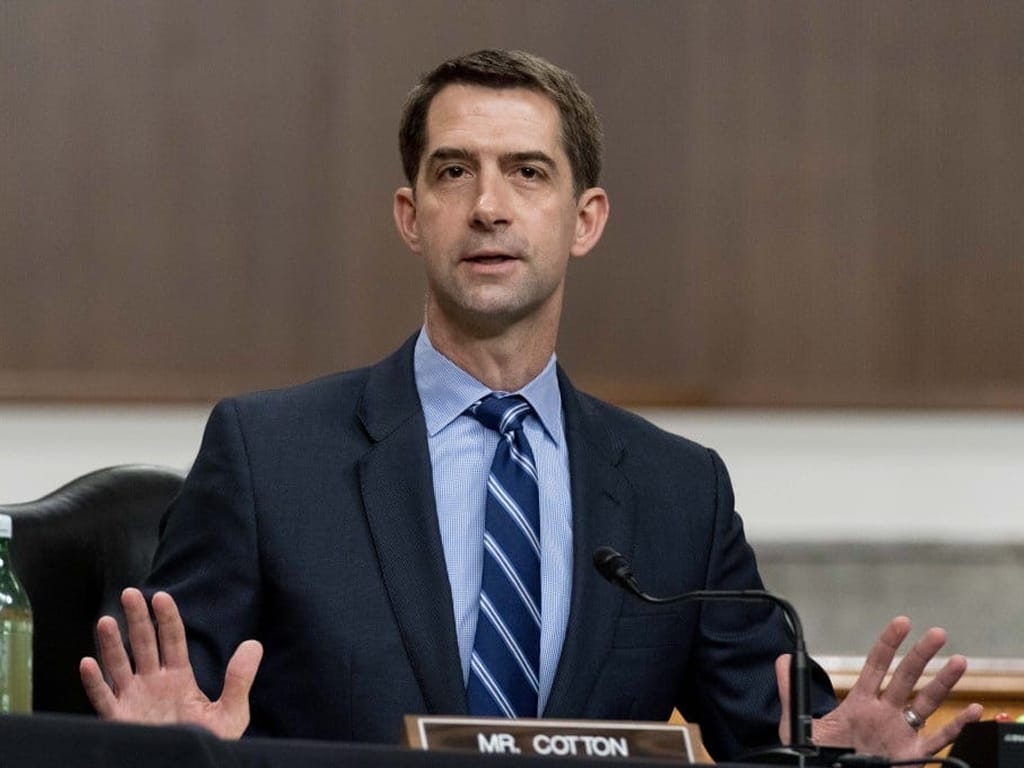
Tom Cotton is seeking another term in the U.S. Senate. A nationally recognized Republican figure and frequent presence on national television, Cotton serves as chair of the Senate Republican Conference and sits on the Senate Intelligence Committee. Those roles place him among the most influential conservative voices in American politics and position him as a close ally of Donald Trump.
His campaign carries the full weight of the party establishment. Cotton has secured endorsements from President Trump, Sarah Huckabee Sanders, and Republican members of Arkansas’ congressional delegation, including Rick Crawford, French Hill, Steve Womack, and Bruce Westerman. He is also backed by national organizations such as AIPAC.
With that institutional backing and his national profile, Cotton enters the race as the clear favorite, and most political observers expect a smooth path to renomination. Still, challengers in both the Republican and Democratic primaries are advancing a different case. They argue that the race is not only about party power or political stature, but about representation, and they contend that Cotton, despite his national influence, no longer reflects the everyday lives and concerns of ordinary Arkansans.
Cotton’s Record and Campaign Message
Tom Cotton was first elected to the U.S. Senate in 2014 after serving one term in the U.S. House of Representatives. He won reelection in 2020 and has now spent more than a decade representing Arkansas in Washington.
His campaign is centered on continuing his conservative agenda and what he describes as delivering tangible results for Arkansans. “I’ve worked with President Donald Trump to deliver for Arkansas’s conservative values: a secure border, a rebuilt military, and lower taxes. I led the fight against Joe Biden’s radical agenda that hurt Arkansas, and conservatives here know I have their back,” Cotton said.
He argues that Arkansans deserve “a trusted conservative who delivers, not just talks.”
Cotton’s campaign website lists inflation as a central issue and highlights his support for tax cuts in the One Big Beautiful Bill Act of 2025. The wide ranging federal spending law also includes long term cuts to Medicaid and food assistance programs.
Late last year, Cotton asked U.S. Agriculture Secretary Brooke Rollins to speed up aid to farmers, though he has faced criticism for his stance on delaying the Farm Bill. He has also focused heavily on China, which he has described as “our most dangerous enemy.” “We must end our economic dependence on China, decouple our supply chains, ban American investment in strategic Chinese industries, protect American intellectual property rights, and punish offshoring American jobs to China,” his campaign website states.
In November, Cotton told THV11 that he opposed extending Affordable Care Act subsidies that would have prevented many Americans’ insurance premiums from increasing. He said the subsidies lacked a clear mechanism to ensure they served only low income Americans.
“Its formal title, the Affordable Care Act, belies the reality because it’s not affordable for Arkansas families,” Cotton said.
The U.S. House passed a bill in January to extend the subsidies, but Senate Republican leadership is not expected to bring the measure to a vote.
Cotton has also echoed Trump’s rhetoric on education. His website says he opposes what it calls “anti American propaganda” in schools, including critical race theory. He presents himself as a loyal Trump ally and a national conservative voice rooted in Arkansas politics.
Republican Primary Challengers
Although much of the political landscape appears to favor Tom Cotton, this election marks the first time since his 2014 victory that he is facing challengers in a Republican primary. Those challengers argue that Cotton has grown disconnected from everyday life in Arkansas and say they are better positioned to represent the state’s local communities and concerns in Washington.
One of those challengers is Jeb Little, a former National Guard medic and current Arkansas State Trooper. Little describes himself as a staunch conservative, though not closely aligned with Donald Trump. He says he offers Republican voters “honest, Christ focused, incorruptible service that is free from career politician ties, super PACs, and special interests.”
“I am focused on restoring accountability and principled leadership in Washington, starting with the full unredacted release of the Epstein files to ensure justice for victims and maximum accountability for the vile people involved, no matter how wealthy and connected they are,” Little said in a statement.
Little said he decided to enter the race in September 2025, after Cotton was among the 51 U.S. senators who voted against an effort to release records connected to convicted sex offender Jeffrey Epstein and his alleged sex trafficking operation. Little said a call to Cotton’s office seeking comment on the vote received no response. “I joined this race because that just didn’t sit right with me,” Little said.
In November, however, Cotton expressed support for legislation ordering the release of the Epstein files, and the Senate later passed that bill unanimously.
Little has also built his campaign around opposition to what he describes as AI overreach, support for legal immigration, and calls for term limits in Washington, D.C. He portrays himself as “someone of the people who will return a phone call and can’t be bought.” He has also said he wants to be a voice for farmers at the federal level and ensure they feel heard “not just during campaign season.”
Faith is another central theme in his campaign. Little has said it is important to “get God back in schools… if we’re truly one nation under God.” His campaign website states that he will “support parents’ rights, defend children, protect religious liberty, and promote policies that reflect Arkansas values, not Washington’s agendas.”
The Republican primary also includes Micah Ashby, a pastor and self described “constitutional conservative.” Ashby said she had been considering a run for office for some time before deciding to challenge Cotton. “I believe that the Constitution is the rule of law,” Ashby said. “It should not be looked over. It should not be bypassed.”
Ashby said her primary concern for Arkansas farmers is the monopoly foreign companies hold over seed markets, and she said she would introduce legislation to break those monopolies.
She has also argued that “politics should not be in school,” pointing to books with what she described as “sexualized” topics, including gender identity. “I believe we should have a neutral education system without politics pushing our children to go one way or the other,” Ashby said.
Democratic Primary Candidates
The Democratic primary features Hallie Shoffner and Ethan Dunbar, two candidates running distinct but overlapping campaigns focused on affordability, representation, and economic pressure in everyday life across Arkansas.
Shoffner, a sixth generation farmer and a mother, has centered her campaign on what she calls restoring the American Dream in Arkansas. “I am a sixth generation farmer. I’m a mom. I am the daughter of two senior parents, and right now I’m running because I believe that we should restore the American Dream to Arkansas,” Shoffner said. “And the idea is that if you work hard and you do everything right, you should succeed.”
She said many Arkansans are struggling with everyday costs and framed her candidacy around representation in Washington. “My message is about having someone who understands these struggles fighting for them every single day in the U.S. Senate,” she said. “I have Arkansas dirt under my fingernails, and I think that’s what people need right now.”
Shoffner said Cotton has overstayed his welcome in Washington and is now “too far away” from the realities of life in Arkansas. “I believe that to fight for Arkansas, you have to know what it’s like to live here right now, and I do,” Shoffner said. “Tom Cotton is a resident of Virginia, and when he comes home, which is rare, he talks to us like he doesn’t like us all that much, that he thinks we’re stupid.” “But this is Arkansas. We are no strangers to making history in this state,” she added. “I believe this can be the most prosperous and healthiest state in the country if we have a leader like me who has some vision for the people of Arkansas.”
Shoffner’s social media presence and her background as a farmer, including speaking publicly about the impact of Trump’s tariffs, have brought her national attention. She has also acknowledged the challenge of running in a predominantly Republican state that has not elected a Democrat statewide since 2010. “I’m not asking anybody to become a Democrat,” Shoffner said. “I’m just asking that you think we can do a hell of a lot better than what we’re doing right now.”
She said her motivation to run came from the sale of her family’s farm. Shoffner said she would support policies that reshape Arkansas’ agricultural market and incentivize farmers to produce food that feeds families rather than primarily fuel and animal feed.
Shoffner also criticized Cotton for voting against the Farm Bill, the federal agriculture spending and policy package that Congress renews regularly. The Farm Bill has not been updated since 2018. Cotton voted against the legislation in 2014, when he was in the U.S. House, and again in 2018, saying both times that the bill allocated too much money to nutrition assistance programs.
Shoffner said affordability is not a new problem in Arkansas, which has long ranked among the poorest states. “We are talking about decades worth of crumbling infrastructure, decades of bad policy that brought us where we are today,” she said.
Dunbar, a 34 year military veteran and the current mayor of Lewisville, has built his campaign around inflation, cost of living, and leadership.
“Look at our inflation, our cost of living, and how it’s affecting our checkbooks now,” Dunbar said. “And who do we think is the best candidate to go and fight for us? And I think I’m the best candidate because I have the extensive experience. I’m a 34 year military veteran and in my second term as mayor in Lewisville.”
Dunbar said his leadership experience in rural Arkansas has prepared him for the U.S. Senate, with a focus on affordability in health care, public schools, and daily living costs. “I think I’m the best candidate because I understand that I live it every day,” he said. “My wife’s on the school board down there, so I’ve got the experience, the leadership, and the desire to be in this race and to serve in this capacity.”
He said serving as mayor in a small south Arkansas city motivated him to seek statewide office. “I feel like I can do a lot of good to help people, especially being a mayor and understanding what the needs are here at the lowest level in rural Arkansas,” Dunbar said.
Dunbar said he would support policies that strengthen the “agricultural safety net,” including subsidies and loans for farmers. He described his home region as one where many residents struggle to make ends meet, including driving “20 to 30 miles for a job that barely pays minimum wage.”
Dunbar said he would support legislation to make child care more affordable and accessible, noting that Lafayette County has no child care centers. He called the situation “a recipe for continued poverty.”
He also emphasized the importance of funding K to 12 public education, saying he would oppose diverting federal funds to private schools and oppose President Trump’s efforts to dismantle the U.S. Department of Education.
Political Reality of the Race
All four challengers have focused more of their attention on Cotton than on one another, both in interviews and in campaign materials. Each argues that they are more closely connected to local communities and better positioned to represent everyday Arkansans than Cotton.
Whatever, Unseating Cotton remains a daunting task.
Cotton has reported more than $9.6 million in the bank for his reelection campaign, a staggering sum compared with his rivals. His Republican challengers’ fundraising totals are negligible by comparison.
Shoffner’s campaign received more than $1 million in contributions between July and December 2025. Dunbar’s campaign finance totals have not been received.
Senators write and vote on federal laws, confirm presidential appointments including Supreme Court justices, ratify treaties, and provide oversight of the executive branch, making it one of the most powerful offices in American government. For Republicans, holding this seat and keeping Cotton in office is a major priority, leaving him with little serious challenge.