Arkansas Corrections Board in Continuing Dispute Over Payment to Former Attorney
The Arkansas Board of Corrections remains locked in a dispute over paying its former attorney amid ongoing legal and political conflict.

As a pro Sanders majority takes control of the Arkansas Board of Corrections, a familiar question has returned: whether the board will pay the attorney it hired to defend its authority during years of litigation over control of the state’s prison system.
At the board’s final meeting last year, before Gov. Sarah Huckabee Sanders’ appointees assumed power, members made a last attempt to resolve the issue. In a specially called meeting, the panel voted to move forward with payment after encountering bureaucratic obstacles. The motion to pay Abtin Mehdizadegan and the law firm where he works passed 4 to 2, with board members Lona McCastlain and Grant Hodges voting no.
Still, the lawyer who represented the Arkansas Board of Corrections through the central legal battles over control of the prison system has not been paid, despite a judge’s order directing that the payment be made. With the board now firmly under the control of Sanders appointees, the prospect of resolution appears more uncertain than ever.
Leadership Change and Political Context
The board that oversees Arkansas’ prison and parole systems now has its first new chairman in two decades, along with a majority of members appointed by Republican Gov. Sarah Huckabee Sanders. The leadership shift follows two years of public confrontation and litigation between Sanders and the seven member panel, a conflict centered on a fundamental question: who ultimately controls the state’s prisons.
The change comes as Sanders also faces the prospect of another significant legislative fight over funding the proposed 3,000 bed prison project in Franklin County. With the board now fully aligned with the governor, questions persist about whether it will move forward with paying the attorney who represented it during those battles.
After Sanders appointed a majority of the board’s members, Abtin Mehdizadegan was fired on Jan. 23 by a 4 to 3 vote. Despite that decision, a state circuit judge had already ordered that the firm be paid for its work and barred the state of Arkansas from preventing the payment of the invoices, after declaring both laws unconstitutional in a summary judgment earlier this year.
The Financial Dispute
The board owes Mehdizadegan $307,193.55, though board member Lee Watson noted that Mehdizadegan continues to represent the board and that the amount will continue to grow. According to the invoices included with a letter sent to the board by the lawyer, the total owed to the Hall Booth Smith firm exceeds $320,000.
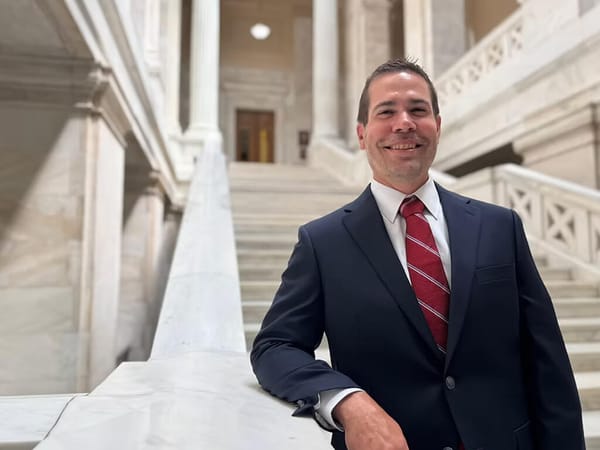
Abtin Mehdizadegan of the Hall Booth Smith law firm sent a letter to all current members of the board, along with 191 pages of unpaid invoices and copies of his motions to withdraw as its attorney in the lawsuits.
“This work was performed under extraordinary circumstances,” Mehdizadegan wrote in the letter. “I defended against relentless litigation tactics, multiple appeals, disqualification motions, legislative subpoenas, weaponized FOIA requests, and ultimately a lawsuit against me personally and my law firm.”
Mehdizadegan confirmed the letter’s authenticity and said he had nothing further to add beyond what he had written.
The Legal Battles Behind the Dispute
Mehdizadegan’s involvement in the dispute stems from his representation of the board in lawsuits challenging two 2023 measures signed by Gov. Sarah Huckabee Sanders. Those laws would have granted the governor authority to hire and fire the head of the corrections department and the directors of its divisions. The board sued, arguing the measures violated the state constitution, and a state judge ultimately blocked them.
Attorney General Tim Griffin later filed a separate lawsuit, claiming the board violated the Arkansas Freedom of Information Act when it hired Mehdizadegan.
When the board first sued Sanders and Profiri in 2023, members chose Mehdizadegan as their attorney on the grounds that the Attorney General Tim Griffin’s office, which would be defending the governor, could not represent both the board and the governor in the same case. That decision later became the basis for another lawsuit filed by Griffin, which alleged that Mehdizadegan’s hiring violated the state’s open meetings law.
That second case has remained entangled in procedural and legal disputes since it was filed. Circuit Judge Tim Fox ordered Griffin to reach an agreement with the board that would allow Mehdizadegan to continue representing it or to approve the hiring of other outside counsel. Griffin failed to do either within the timeframe Fox set, and Fox dismissed the lawsuit as a result.
In May, the Arkansas Supreme Court reversed that dismissal, finding that it would have been impossible for Griffin to comply with Fox’s instructions under Arkansas law and ordering the case to proceed.
Court Orders and Continuing Conflict
Circuit Court Judge James’ October order put the issue in stark terms: the board has a legal obligation to pay Mehdizadegan.
“The Board’s constitutional authority to exercise ‘control’ over the Department necessarily includes the practical ability to retain and compensate special counsel to vindicate and protect that control in court, both today and in the future,” she wrote.
Yet despite the clarity of that ruling, payment for Mehdizadegan’s work has remained one of the most fiercely contested issues in the wider legal struggle.
In a Feb. 2 letter, Mehdizadegan accused the board of acting in a manner “beneath the dignity of a constitutional body.” He focused in particular on last month’s motion to fire him, which described his hiring as “illegal.” A Pulaski County Circuit Court judge had “explicitly confirmed” last year that the engagement complied with state law, he wrote, calling any claim to the contrary “factually and legally incorrect.”
Mehdizadegan acknowledged that the board has the authority to terminate his services, but said that decision does not eliminate its obligation to pay him and his firm for work already performed.
“By attempting to recharacterize a court validated engagement as ‘illegal’ to justify non payment, the Board is not merely engaging in a fee dispute,” he wrote. “It is participating in the same erosion of institutional integrity that we once stood together to oppose, all in breach of our contract together.”
With Gov. Sarah Huckabee Sanders, Attorney General Tim Griffin, and state finance officials now aligned against him, the chances that Mehdizadegan will ever be paid appear increasingly slim.