A Dean’s Search, a State’s Politics, and a Campus Caught in Between
The University of Arkansas begins a search for an interim law school dean after a revoked appointment sparks political backlash, campus protests, and a broader clash between liberals and conservatives.

Ordinarily, the appointment of a law school dean would draw little attention, just another routine decision among the state’s many higher education institutions. But as political polarization has deepened, academic leadership roles have become part of broader ideological battles, including at one of Arkansas’ most prominent universities, the University of Arkansas.
Three weeks after the university withdrew its offer to Emily Suski, liberal leaning, following complaints from key Republicans about her background and legal positions on transgender athletes, the University of Arkansas began its search Friday for an interim law school dean, seeking a path forward without further conflict, even as university leaders remain under intense political pressure and protest from students.
Political Pressure and Academic Freedom
Complaints from lawmakers about Arkansas’ colleges and universities are hardly new. For years, legislators have made their displeasure known to campus leaders when they or their constituents were dissatisfied. More often than not, those disputes revolved around football coaches, not law school deans.
But this latest episode reflects a deeper political shift. In a deeply conservative state, liberal politics are increasingly treated as unwelcome in public institutions. Many conservative leaders view colleges as breeding grounds for progressive movements they oppose, and that tension has only intensified since the withdrawal of the offer. The speed with which the University of Arkansas withdrew its offer to Suski signals a different moment for higher education in the state, sending a clear message about how quickly institutions may yield to political pressure.
The university’s reversal has also drawn national attention to the broader question of academic freedom. Across the country, schools are facing rising Republican scrutiny, from President Donald Trump to state officials.
The decision to revoke Suski’s offer triggered a left leaning, student led protest and prompted complaints that the university had violated principles of academic freedom and chilled faculty speech. Yet the protests appeared to have little impact on the university’s course, underscoring how closely academic freedom in Arkansas has become tied to the state’s political power structure.
Legal Context and Constitutional Authority
An Arkansas Supreme Court decision last year may reshape the balance of power between the Republican Legislature and the state’s higher education system. In a unanimous ruling, the court said the Legislature has the authority to scale back constitutional amendments that were proposed and approved by voters.
That decision could open the door for lawmakers to exert greater control over higher education, including more direct influence over hiring and firing decisions.
It may also allow the Legislature to revisit the constitutional amendment designed to give colleges and universities institutional independence, an independence Suski’s defenders say is now at risk.
That amendment, known as Amendment 33, was ratified in 1942 in response to political interference at the University of Arkansas. At the time, the university faced pressure from Democratic Gov. Homer Adkins, who sought to remove then-president and future U.S. senator J. William Fulbright.
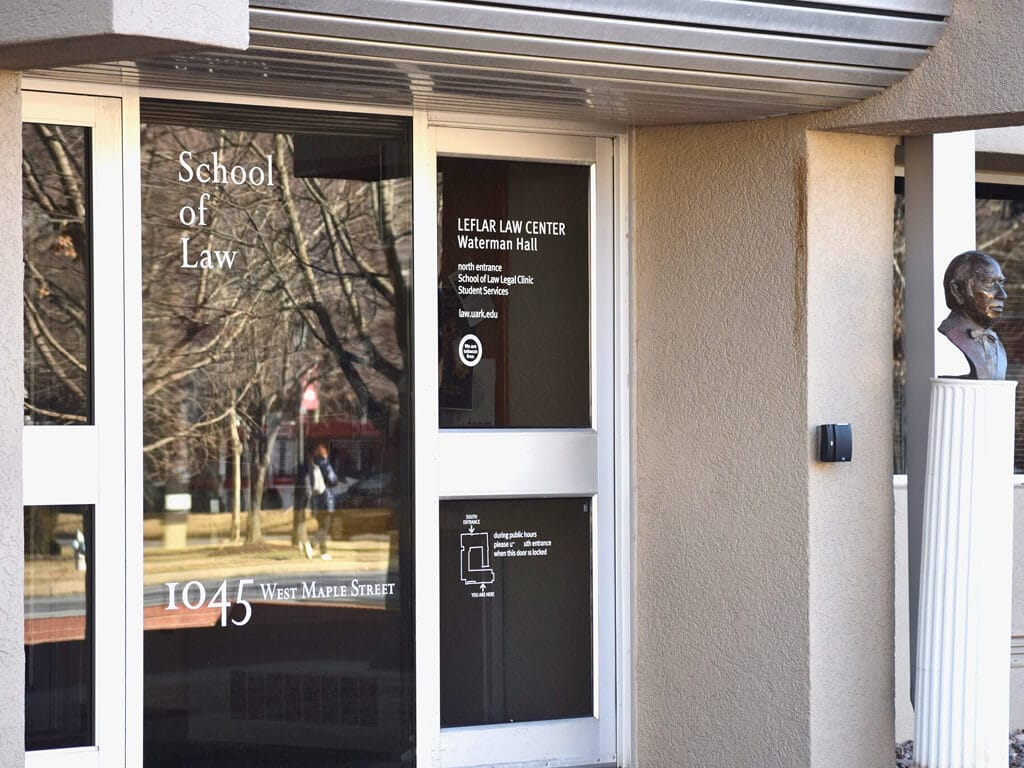
In a historical irony, it was another law school dean, Robert Leflar, who played a central role in that earlier fight over higher education’s independence.
The University of Arkansas’ flagship campus has already taken steps that reflect higher education’s growing role in cultural and political battles. In 2023, the university closed its diversity, equity and inclusion office. Late last year, it removed the head of its Middle East Studies office over comments made about Israel.
The school also posted Ten Commandments displays on the Fayetteville campus in compliance with a 2025 state law, a move that led an alumnus to withdraw two scholarships he had funded.
Republicans now hold an overwhelming legislative majority, giving them the power to turn routine budget holds, long a challenge for universities and other state agencies, into serious obstacles when the fiscal session begins in April.
National Backlash and Local Impact
More than 150 law professors from universities across the country signed a letter criticizing the University of Arkansas’ decision to revoke Suski’s offer. Sent on Feb. 1, the letter was addressed to the Arkansas General Assembly, Gov. Sarah Huckabee Sanders, Provost Indrajeet Chaubey, and University of Arkansas System President Jay Silveria.
The backlash has generated unwanted national attention for the university. In Arkansas, the decision prompted a student walkout and deepened concerns among faculty about their own freedom of speech. At the same time, the controversy has unfolded within a broader political climate in which many state leaders have aligned themselves with the governor, framing the debate around Christian values and casting liberal politics as fundamentally at odds with the state’s dominant conservative identity.
Search for an Interim Dean Begins
Provost Indrajeet Chaubey said in an email to law school staff Friday, February 6, that after meeting with the law dean search committee earlier in the week, the university decided to conclude the current dean search and begin identifying an interim dean to succeed Dean Cynthia Nance.
As part of the process, Chaubey encouraged faculty and staff to send recommendations of tenured law school faculty who hold the rank of professor or higher by 5 p.m. Feb. 13. He said he would reach out to all nominated faculty and then seek feedback from law school faculty and staff on candidates who wish to be considered for the interim position.
Chaubey thanked staff for their recent feedback, which he said was being taken “very seriously.”
“I am deeply committed to working with all of you to find the school’s next leader,” he said. “I appreciate your patience as we determine the best path forward.”
The challenge for university leaders is how to reassure faculty and students that the institution is not surrendering administrative independence to lawmakers, or allowing curriculum vitae and academic records to be politically scrutinized in a deeply Republican state.
The appointment of a new interim dean is expected to be closely scrutinized amid the political controversy. If the new leader is seen as left-leaning, Republican opposition is likely to continue. If the appointee is perceived as aligned with conservative politics, protests from students and faculty are expected. Either path places the university in a deeply polarized environment.
At the same time, those reassurances must be delivered without provoking a deeper confrontation with the Legislature over who controls higher education in Arkansas.
It is a difficult, and possibly impossible, balancing act that could shape not only the future of the Fayetteville campus, but the future of higher education across the state.